 |  |  |
|---|---|---|
 |  |  |
 |  |  |
 |  | 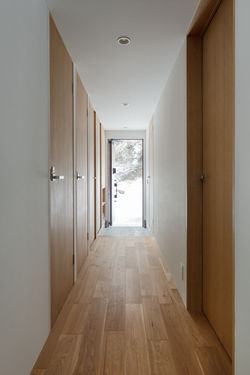 |
Photo by Takumi Ota
高野山の庫裏
和歌山県・高野山奥之院のほど近く。
弘法大師空海が修行の地として選んだこの地は、宗教的精神性と同時に、建築にとって極めて苛烈な環境条件を内包している。
厳冬期には一昼夜で最大20℃近い寒暖差が生じ、急激な温度変化によるムペンバ効果的な凍結が発生する。
高野山の暮らしは精神性だけでなく、環境への適応そのものが修行でもある。
本計画は若い僧侶とその家族のための住宅であり、寺院建築における「庫裡」と「伽藍」という概念を本計画に写し取る試みである。
外観は、高野山の景観と宗教的背景に配慮し、過度な装飾性を排した。建築の輪郭は極めてプレーンな矩形とし、道路側には窓を極力設けないことで外界との距離を保っている。
平面は短辺5.4m、長辺14.5mの矩形を基本とし、長手方向を5.2m、5.7m、3.6mの三つのブロックに分節した構成とした。
中央のブロックのみを吹抜けをもつ単層空間とし、両端のブロックはそれぞれ1.5層、2層のスキップフロアとすることで、限られたボリュームの中に多様な居場所を内包している。
玄関に近い1.5層のブロックには、寝室、書斎、ウォークインクローゼット、トイレを集約し、上部はロフトとして利用する。
一方、奥側の2層ブロックは、下階を1.5m地中に埋設した半地下構成とし、浴室、脱衣室、書斎、ライブラリーを配置した。
水回りを地中に近づけることで、地表の急激な温度変化の影響を抑え、地熱を利用した安定した温熱環境を確保している。
これはムペンバ効果的な急激な凍結への応答である。
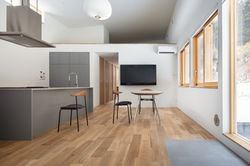
中央の吹抜け空間は、天井高最大4.2mのリビング・ダイニング・キッチンであり、本住宅の精神的・空間的中心となる。
「がらんどう」という言葉は空虚さを意味するが、本計画が目指したのは仏教的な意味での「伽藍洞」である。
空でありながら中心を持つ空間。庫裡=厨房を核に据え、生活と修行、家族と宗教性が緩やかに重なり合う場とした。
本計画は、寺院建築における「庫裡」および「伽藍」という伝統的概念を参照しつつ、現代の生活様式および厳寒環境に適応した住宅形式を目的とする。
Located near Okunoin on Mount Koya in Wakayama Prefecture, this residence stands within an environment shaped by both spiritual practice and severe climatic conditions.
Chosen by Kobo Daishi Kukai as a place for ascetic training, Mount Koya is known not only for its religious significance, but also for its harsh natural environment.
During the depths of winter, temperatures can fluctuate by nearly 20°C within a single day, causing rapid freeze-thaw cycles that place considerable stress on architecture.
Life on Mount Koya is not only about spirituality; adapting to the environment itself becomes a form of spiritual discipline.
This project was designed as a residence for a young monk and his family, reinterpreting the traditional relationship between the *kuri* — the kitchen and living quarters of a temple — and the *garan*, the central temple compound found in Buddhist temple architecture.
The exterior responds to the landscape and religious context of Mount Koya through restraint rather than expression.
The building is composed as a simple rectangular volume, and by minimizing openings toward the street, it maintains a measured distance from the outside world.
The floor plan is based on a rectangle measuring 5.4 meters on the short side and 14.5 meters on the long side, divided longitudinally into three blocks measuring 5.2 meters, 5.7 meters, and 3.6 meters respectively.
Only the central block is designed as a single-story volume with an atrium, while the blocks at either end adopt split-level configurations of one-and-a-half and two stories. This arrangement allows a variety of living spaces to be accommodated within a limited building volume.
The one-and-a-half-story block near the entrance contains the bedroom, study, walk-in closet, and restroom, with the upper portion utilized as a loft.
Meanwhile, the two-story block at the rear incorporates a semi-basement condition, with the lower floor embedded 1.5 meters into the ground.
This area contains the bathroom, dressing room, study, and library.
By locating the wet areas close to the earth, the design utilizes geothermal stability to moderate rapid outdoor temperature fluctuations and maintain a more stable thermal environment during winter.
This architectural response emerged from the severe freezing conditions characteristic of Mount Koya’s climate.
At the center of the house, the atrium space functions as the living, dining, and kitchen area, rising to a ceiling height of 4.2 meters.
It forms both the spatial and spiritual center of the residence.
While the word *garando* commonly refers to emptiness or hollowness, this project sought to embody the Buddhist notion of *garando* (伽藍洞).
An empty space that nevertheless possesses a center.
Organized around the kitchen as a contemporary interpretation of the *kuri*, the house was conceived as a place where daily life and spiritual practice, as well as family life and religious life, gently overlap.
While referencing the traditional relationship between *kuri* and *garan* found in temple architecture, the project ultimately seeks a contemporary residential form adapted to modern life and the severe winter climate of Mount Koya.
■建築概要
題名:高野山の庫裏
設計:尾形良樹+SALT
設計協力:岸本姫野建築設計事務所
担当:尾形良樹,藤原唯
什器:iei studio 永田幹,見島 弘将
所在地:和歌山県伊都郡高野町
主用途:住宅
施工:かじさ建築店
構造:木造
階数:地上2階
竣工日:2025年12月
写真:太田拓実
■General Information
Title:The Kuri of Koyasan
Design:Ogata Yoshiki+SALT
Design Collaboration:KishimotoHimeno Architectural design office https://www.kishimotohimeno.com/
PIC:Yoshiki Ogata,Yui Fujiwara
Furniture:Kan Nagata,Mishima Kosuke from iei studio https://ieeei.jp/
Location:Koya Town, Ito-gun, Wakayama, Japan
Principle Use:House
Construction:Kajisa Corp. https://k-kajisa.com/
Structure:Timber
Number of Stories:2F
Completion:December, 2025
Photo:Takumi Ota